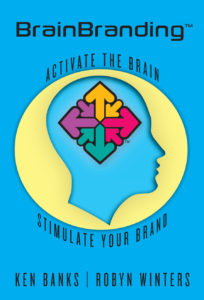
“COMING SOON: BrainBranding, The Manual. Read the book, then use this workbook to develop a brand strategy that works for all four buying styles.
Please note that KAB Marketing is no longer operating as a consulting and presentations company. The Blog "What's Branding Got to Do with it?" will continue to be published on a regular basis.
A couple months ago, I wrote an article supporting JC Penney’s new brand strategy and creative execution, indicating that it was the right thing to do to get the store back on track and differentiate itself in the marketplace. With the dismal performance in revenue and profits, the declining stock price, and the exit of some key top executives, many of you have questioned my wisdom and have asked me “What now?” for the beleaguered retailer.
 With the political campaigns at full speed, I’m reminded of a famous quote from the 1964 Republican candidate
  Barry Goldwater who defended his views when he said “Extremism in the pursuit of liberty is no vice.” Although I couldn’t vote then, I do remember that the voters rejected his extreme right views and with the exception of Goldwater’s home state and the Deep South, he was soundly rejected in favor of Lyndon Johnson. The pendulum would swing too far right and they would not accept that much change.
Retailers face the same challenge when they go through a re-branding process and eliminate every way they promoted in the past to go for the new strategy. Food retailers have done this when they have decided to give up on weekly ad and in-store specials and coupons for EDLP only to discover that the customers still want those specials in the store with the signs telling them how much they are saving. Since POP promotions generate over 80% of the sales, it’s no wonder that the average market basket goes down quickly and the customer doesn’t think she is getting the best prices. EDLP does work, but the stores need to keep some promotional excitement at the store and in their ads.
I still believe that going to an everyday pricing strategy works. After all, look at Wal-Mart and the success they have had. However, even the world’s largest retailer still runs a monthly circular to feature those low prices on the most wanted items at that time of year. Their in-store price reductions have long generated sales and a stronger low price position with their customers, and they continue to do that successfully with their shopping list comparisons for food today.
JCP should have made a strong, logical pitch to its customers about a new everyday pricing strategy supported by an edited down version of their aggressive print sales circulars and mailers. However, the confusing sometimes lower prices and sometimes clearance events coupled with less in-store signing excitement seems to have convinced their loyal customers (and some of those Kohl’s shoppers) that their specials weren’t as good as before. With the aggressive media campaign and break-through creative, they reached a lot of customers with that message.
I still think JCP’s new print creative is outstanding, their broadcast cuts through the clutter, and their stores are better merchandised. However, they went to extremes by downplaying their price points graphically and not defending themselves against Kohl’s and Macy’s who increased their aggressive sales promotion. The solution? Michael Francis, JCP’s deposed President who came from Target, should have stuck with what worked at his former store. Great creative, excellent everyday pricing, and aggressive and well-presented print promotions. Going to extremes didn’t work in 1964 and didn’t work in the malls of 2012
UPDATE 8/8–AL RIES JUST WROTE A GREAT ARTICLE ON THE SUBJECT IN AD AGE ON JCP. CHECK IT OUT AT http://adage.com/article/al-ries/al-ries-prescription-fix-jc-penney-retail-reinvention/236564/?utm_source=cmo_strategy&utm_medium=newsletter&utm_campaign=adage
 Ken Banks and Robyn Winters (co-authors of BrainBranding-Activate the Brain, Stimulate the Brand) are contributing authors to the new professional speakers reference book, Speak More, recently published by the National Speakers Association. It’s available on Amazon/Kindle and features marketing tips from 33 of NSA best speaker marketers. Here’s the description from Amazon. BrainBranding reaches out!
SPEAK MORE! PROVIDES CUTTING-EDGE, ROAD-TESTED, AND COMMONSENSE MARKETING STRATEGIES TO HELP PROFESSIONAL SPEAKERS ACHIEVE THEIR BUSINESS OBJECTIVES. Thirty-three members of the National Speakers Association (NSA), including renowned business experts, authors, and marketing gurus, share their sage advice for setting yourself apart from the competition. Whether you peruse the table of contents to find topics that pique your interest or read the book from cover to cover, you’ll discover real-life experiences describing what works and what doesn’t to effectively promote your business, brand, products, and services, and to grow your bottom line. LEARN FROM THE BEST AS YOU READ HOW TO: • Develop a strong personal brand • Get the most out of networking and public relations e orts • Publish a book to propel you from a speaker to an expert • Achieve a professional appearance to enhance your brand • Harness the power of social media • Create a do-it-yourself video • Launch your own radio show • Turn cold calls into hot new prospects • Snag and prepare for media interviews in your field • Optimize mobile marketing with QR codes • Go global with your message • And much more! Speak More! is tailored for keynote speakers, consultants, coaches, trainers, authors, and anyone seeking to expand the reach of their message. Many of the proven methods require little or no monetary investment, yet they provide big payoffs, including increased revenues and opportunities to speak more!
To order on Amazon, just Click HERE
I’m writing this month’s article from Prague, Czech Republic, shortly after returning from a walking tour of this vibrant city on a beautiful Sunday afternoon. It’s a wonderful day and the citizens (and tourists like us) enjoyed all that the city has to offer. With so much history and beauty, it’s hard to believe the Czech Republic is less than 20 years old as a country. After all the years of Communist oppression and turmoil, the country has emerged with it’s own personality and attitude that is not unlike many of the new brands that have established themselves in the marketplace in the past few years.
We tend to think that building a brand relationship is a long-term process that takes years of marketing and research to reach the top of the consumers’ preferences. Yet, it really is simply a matter of doing the right things first to determine where your brand’s niche is and how you can differentiate yourself from the competition in order to generate sales. Granted there are those “Hall of Fame” brands like Coca Cola, McDonalds, IBM, etc. that continually renew themselves and maintain their preference with the customer. However, there are plenty of new brands on the block like Zappos, Android, Whole Foods, Smart Car, LG, and Under Armor that have created powerful brands by following the steps necessary to define their brands before they ever started marketing them.
It all starts with having a Vision for your brand and determining what is going to differentiate you from the others in the same market. Not simply providing a new name or a new version of an existing brand, but creating one that meets a customer need and providing the value that will warrant their trial—quickly.
Next, you have to do the research necessary to quantify where your potential will be and who the competition is. A SWOT analysis is helpful, but it’s important to evaluate the market potential, the customer attitudes and perceptions, and the competitive perceptions before you move forward.
Taking these first couple steps with a sense of urgency can establish a brand quickly or (as in the case of Prague and it’s homeland) re-inventing a brand by building on its strengths and addressing its weakness before moving forward. An effective marketing and communications plan is a lot easier to develop once you take the time to make sure your brand is relevant and interesting.
COMING SOON: BRAIN BRANDING. THE MANUAL.
An easy to follow guide to building a brand that resonates with your customers.
Whenever I talk with marketers and ad agencies, the conversation inevitably gets to whether breakthrough creative or a sound brand strategy is more important to the success of a product or service. Of course, I always answer “Both!”. What’s really important is the order in which these two challenges are addressed. So often, marketers (especially retailers) are so pressured to produce some immediate results that they rush to get out a new campaign or spot and make some noise that will result in more sales. Now, if the brand strategy that’s in place is already working and well developed, getting new creative may just be the answer. However, usually the fact that what’s currently reaching your customers isn’t working well is the result of poor branding in the first place.
This seems obvious to me and I believe that the really creative advertising gurus also agree that the brand comes first and then the creative. I recently received a DVD in the mail from a good friend, Cedar Hames, who is CEO and founder of a local agency here in St. Petersburg. To celebrate the 10th anniversary of Paradise Advertising, Cedar sent a complimentary copy of a PBS documentary from a couple years ago, title “Art & Copy”. The show featured interviews with some of the true great creative minds in the advertising business talking about their craft and some of the outstanding work that is legend in our business. The group included Mary Wells, the late Hal Riney, George Lois, Dan Wieden, Lee Clow, and others. To learn more about the program, go to http://www.pbs.org/independentlens/art-and-copy/film.html and I’m sure you can download or get a copy of the 90 minute program.
I won’t go into the details of each person’s comments on the program here, but it became obvious to me that they are/were all risk takers who dared to breakthrough with great spots like VW’s Think Small, Apple’s 1984, or Braniff Airlines’ Flying Colors. However, to the person they spoke highly of their clients and the direction they received from them. This was manifested in a brand strategy that reflected a thorough understanding of the market, the customer, and the competition. Developing a successful brand strategy is part of the process and opens the door for art and copy that truly breaks through and resonates with the four buying styles we talk about in our book (co-authored with Robyn Winters): BrainBranding—Activate the Brain, Stimulate Your Brand.
With so much mediocre advertising out there today (a great deal of which is from top companies and major brands), it would be beneficial for many of the marketers responsible to sit down and listen to what these “icons of creativity” had to say. It will make for great advertising and, more importantly, for successful brands.
“COMING SOON: BrainBranding, The Manual. Read the book, then use this workbook to develop a brand strategy that works for all four buying styles.
If you have been reading these articles over the past couple years, you know that I have often questioned the strategies of stores like JCPenney and Kohl’s since it seemed that they must have had investments in a printing company or paper mills with the amount of print advertising that they have been pouring out. Moreover, it was hard to tell one sale ad from another and to understand if these sales circulars and the strategy behind them really broke through to the customers and motivated them into the stores. Differentiation certainly was not one of the objectives in my opinion.
That’s why I was really interested when JCPenney made some significant moves in marketing in 2011. In addition to Ron Johnson taking over at CEO and bringing his Target and Apple heritage with him, Michael Francis also made the move from Minneapolis to Plano as President. The results, I think have been noteworthy. I’ve always felt that Penney’s did a great job with running stores with exceptional displays and merchandising and their aggressive broadcast advertising under Mike Boylston was some of the best in the industry. However, they seemed to be obsessed with trying to out-promote their similar competition. How often can you have “lowest prices of the season” or a “one-two-three day sale” before the customer gets bored and ignores you. Certainly, Kohl’s continues to follow this promotional format, but their brand has been carefully developed with a new and younger shopper who has rejected JCPenney as “their mother’s store.” It was time to break that mold, and I think they are shaking it up with a good, sound creative strategy. The Ellen DeGeneres campaign not only broke through with humor and universally liked spokesperson but it also made a logical and sensible argument that has made WalMart the largest retailer in the world—no nonsense, every day low prices. The other broadcast spots have complemented Ellen’s message and have added some real creativity to what has been a retail wasteland in broadcast. The stores have been upgraded and the merchandise is better than ever.
 However, I think it’s the print advertising that stands out more than anything else for the jcp brand. It’s not simply Target advertising with a new logo. There are strong messages to go along with outstanding layout and photography. Simple yet striking. The ads make you want to read on and moreover, take a trip to see the stuff in the store. Yes, they still promote special prices on the first and third Friday (who’s going to remember that?) but in the atmosphere of these striking ad messages, even that seems to make sense. A recent article in the New York Times discussed the fact that most customers really liked and used coupons. Yes, we do (especially for pizza!). But the success of the largest retailer shows that a believable low price strategy can trump the one week specials over and over again.
Finally, what about the name change? They had to communicate that things have changed and while the jcp logo is simple and contemporary, I think it sends a message of new and young, while maintaining the identity of the parent that has a long heritage in fashion and home. It will be interesting to watch what happens now since it will likely take the customers a while to come back and give jcp a try, but with the sound brand strategy in place and the creativity that’s already been shown, there’s a great chance for success.
Once again I watched a Hallmark Hall of Fame original movie the other night and was impressed as always by the quality of the commercials that ran throughout the show. Some of these have been running for a few years (at least) and yet they still make the point and re-emphasize Hallmark’s position as the best brand in greeting cards and gifts year after year. The company understands its customers and understands the motivation behind sending a greeting for a special occasion.
However, what is impressive is the way Hallmark has aggressively solidified its position by changing with the times with creative use of the media. The Hallmark channel is one of the best vehicles for getting out the Hallmark message without seeming like your simply watching another commercial. The programming over the holiday’s is sheer genius as the non-stop holiday movies (some new, some repeats) that all seem to have the same message, but somehow manage to get you in the spirit of the season and provide an alternative to the reality shows and pre-event music awards concerts that fill the airwaves in between college and pro football games. The Hall of Fame specials continue to provide the best quality programs year after year without overdoing it and provide an excellent environment for the branding message that Hallmark consistently maintains every year. Add to this, Hallmark’s online subscriptions for e-cards which gives us the opportunity to send “the very best” online easily and economically. No doubt the internet and social networking has made a huge dent in the conventional greeting card business, but Hallmark has filled the void and gives you the opportunity to personalize while maintaining the Hallmark brand assurance.
 This brings me to another brand message at this time of year. This month’s Hall of Fame movie was “Have a Little Faith” based on Mitch Albom’s latest book of the same name. I’m a big fan of Albom’s books and this one was particularly poignant.
It’s the story of his encounter with two clergymen—his rabbi from his youth and an African-American minister in a broken-down Detroit slum church. I was particularly moved by the wisdom shared by Albert Lewis, Albom’s New Jersey rabbi, who asked him to write his eulogy and then spent 8 years sharing that wisdom with Mitch. In one conversation, Rabbi Lewis tells Mitch that one of life’s great challenges is to answer the question: “What is your glory?” In other words, what have you done to make the world a better place. It’s from this question, that Albom’s faith and commitment is awakened and drives him to help the Detroit church as well as his family and community. I’ve often asked my branding audiences and college classes to think about “What their brand’s are famous for?” in their quest to make their brand’s (product or personal) more successful. However, it struck me as I watched the movie that it’s the “glory” of our brand that makes it successful and enables it to stand out from the competition while building a relationship with your customers.
At this time of year, when we hear the word “glory” in many of the carols of the season. I hope that you consider what you can do to make a difference in the world as well through your personal and corporate brands. Like the companies (i.e. Hallmark) that stand out year after year during the holidays without relying on just another sale, you, too, can find the glory of the real meaning of this season.
Merry Christmas.
Ken
CLICK PLAY>>TO VIEW THIS MONTH’S BLOG AND VIDEO>>>
Recent reports by CBS News and The Bloomberg Report rave about the performance that KFC restaurants have had in China. With over 3200 stores there now, the chain is outselling McDonald’s and the other US fast food chains significantly. While domestic performance isn’t as great, my trip to KFC’s first restaurant in Corbin, KY, gave me a clue as to why the chain is one of the strongest brands in the business.
Over the door inside of the original Sanders Café is a sign that defines Good Will as “The Disposition of a Well-Pleased Customer to Return to the Place where he has been well Treated.” This is identified as the definition by the US Supreme Court, but it certainly is also the benchmark of successful brands who deal directly with their customers. It’s interesting that KFC is doing so well in China when the experience here does not always live up to the above definition. However, when you read more into the reports and learn how not only has KFC’s parent YUM Brands made a practice of hiring local managers for their stores and operations, but also the restaurants have catered to their customers by having local favorites to the menus and added design and architecture to make it feel like they are at home and not in an American icon in a strange place.
Marshall Field, the department store pioneer, best described Good Will as the only asset that a store’s competition can neither duplicate or destroy. It is, in fact, the basis for a long-term relationship that also defines a successful brand. While Colonel Sanders built his brand on his secret batter recipe (which the company still keeps securely locked up in Louisville), he also understood the importance of treating his customers with a smile and with respect. The original café displays a lot of evidence that the reflect a respect for the customer and the warmth of family place to dine. On the same trip, we stopped at a McDonald’s in Lima, OH, that was designed with fixtures and accessories that made it feel not just like an upscale restaurant but gave it a warm, homey atmosphere as well. (The mocha frappe was as good as ever, too.)
As I look at stores and restaurants that are struggling recently, I think it would be good for them to take note of the Colonel’s adherence to building good will by building a brand that resonates with their buying style and keeps them coming back to a place “where they are well treated”.
To learn more about how to make your brand more successful, watch for our new book: “BrainBranding. Activate the Brain—Stimulate the Brand.” Co-authored by Robyn Winters and myself, the book will be available on Amazon and Kindle later this month. Watch for our announcement soon.
While the amount of advertising in traditional media has gone down in the past couple years, it’s still amazing to see so many ads that appear regularly that don’t seem to have any reason for being other than to fulfill a long-term media contract.
Some of the circulars that run every week—and sometimes twice a week—have about as much subpoena for the customer to read and then shop as the legal notices that still appear in the classified section. The customers have to be bored and I suspect that the advertising staffs at many retailers are bored as well.
This is especially true for the ROP ads that continue to be placed by major department store chains. The ads fill space, but certainly don’t provide any reason to chose one store over another. The item selection isn’t much more interesting and the prices are ho-hum. So why do they run these ads anyway? Sometimes I wonder if anybody at corporate is paying attention!
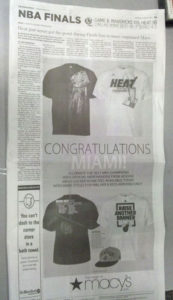 Case in point is the now famous ad that Macy’s ran in the Miami market the day after the sixth game of the NBA championship series between the Heat and the Dallas Mavericks. The ad congratulated the Miami Heat on their championship and featured team products on sale to celebrate. Only problem was that Dallas won not only that game but the championship. Even if the Heat had won that Sunday’s game, they would still have had to play one more game to decide the championship. Knowing the power of the press, I became skeptical that maybe that was the plan all along and that the media event that ensued might have been exactly what Macy’s wanted. I never checked to see if they ran one in Dallas/Ft. Worth as well. Overall though, it’s just another case of advertising that does nothing to enhance the brand and build a relationship with the customer.
Many of the ads that appear every week—week after week—seem to have as much marketing thought behind them as the signage on some of the windows of the stores. Knowing the cost of these ads, can you image what could be done if they created messages that inspired the customers to like the store and differentiate it from their competitors. Retailers complain about the economy and tight budgets, but then there are wasted media dollars that do nothing but satisfy a contract or fill an already boring ad calendar.
It’s time to start watching our ads and making sure that there is a reason for being in every message. And that reason can’t just be to clear out sports memorabilia for a team that was as inspired as the advertising for the store.
 COMING SOON: Robyn Winters and I have just completed a book on branding with a revolutionary point of view. Brain Branding, Activate the Brain—Stimulate Your Brand is in its final edit and will be available on Amazon and your Kindle very soon. Watch this blog for a special introductory offer!!
Standing at the highest point in San Francisco, one can’t help breaking into a chorus of “I left my heart in San Francisco”. I’ve been there many times throughout the years and still get a thrill every time I visit whether on business or for pleasure. I’ve often said that I’d rather go back to the “city by the Bay” 10 more times than take one trip to a third world country. San Francisco is more than a city. It’s a brand. I don’t know anyone who doesn’t have a special feeling or relationship with the city. Thinking about it, shouldn’t a store or product have the same time of feeling toward its brand as well. Without a relationship, I always say, there is no brand. This is what the Heart of the Brand is all about. So much of today’s marketing is focused solely on the Truth of the Brand (i.e. the facts, just the facts) that the customer fails to have any feelings (good or bad) about that brand and sees it as just another storefront or product on the shelf.
The other night I decided to watch one of the top rated TV shows and take note of the commercials that ran both on the network as well as the local breaks. During that one-hour program, there were, by my count, 12 commercials and not one of them gave any reason beyond price/promotional deal or product facts for the viewer to consider purchasing the advertised product. So, where’s the branding? It seems like most advertisers have abandoned trying to build an emotional relationship with the customer and give him/her a distinguishable value that would convince them to buy.
There are exceptions and it’s no surprise that the companies that have a message targeted at the heart of the customer are the one’s who continue to grow their market share.
Publix food stores are a great example. First, the company runs really great stores that are clean, efficient, and staffed by generally friendly, helpful people. But when it comes to advertising, the company goes beyond its ongoing BOGO offers to remain price competitive by running commercials and offering mailings that remind us that having dinners and lunches with our families are important. Over Easter, while most food stores hawk their discounts on the Easter hams, Publix ran (for the second year at least) a 60 second spot that celebrates a family dinner and a special relationship between a brother and sister that tugs at your heart and builds a relationship with the brand at the same time.
The company does this all year by tying in important family gatherings with the benefits of shopping at a store that’s part of the family for years.
Crate & Barrel has grown over the years by providing a great shopping environment, with neat and exciting merchandise that translates to the home experience as well. It has assumed the role, over the years, as the contemporary customer’s lifestyle guide and makes one feel at home whenever he/she comes into the store. Their advertising has always been as cool as the stores making the merchandise come alive and relevant to the lifestyle of their customers. While their prices are competitive with all the mass merchants, the company realizes that it’s an emotional choice to shop there and it’s all part of being a welcome guest in our homes.
Walgreen’s recently announced that it was installing charging stations for electric cars in 150 of its Chicagoland stores. This is just one more step in the company’s commitment to providing the convenience that today’s drugstore customer expects when they visit the stores as many as 3-4 times per week. Whether it’s in-store medical clinics (that I have found to be really are professional and caring ) or pharmacy systems that really make filling and re-filling prescriptions almost effortless. To have a pharmacist call you personally to offer to go over all of your medications and give you an assessment and summary has nothing to do with $4 generics, but it has everything to do with keeping you healthy and keeping you as a loyal customer in the future. The stores are as promotional as ever, but when it comes down to it they know that their customers are need driven and they have to meet those needs consistently to reach the heart of the loyal shopper.
Home Depot has gotten back on the track that made it so successful over the years by providing helpful customer service in every aisle. On a recent trip to “just pick up a couple of things”, I was approached by a smiling, friendly orange-aproned associate making sure that I found what I needed and offering to help with any questions that I might have (and who doesn’t have questions when you’re at Home Depot? The company’s support of the Olympic athletes over the year is more than just a good marketing handle, it’s representative of the heart of this brand as a good neighbor and good citizen. The recent rash of tornadoes and floods have moved the local stores to action as the caring company to help you through really tough times.
Chrysler just announced a quarterly profit for the first time in over five years and I don’t think it’s because of their new relationship with Fiat or divorce from Daimler Benz. Besides appealing to its employees and U.S. customers as a Detroit-based company with great American standards, Chrysler has improved its messages in the media with a straightforward approach that gets to the heart of the customer a lot more effectively than another Toyotathon or factory rebate/$100 off factory invoice promotion. The company shed itself of many underperforming brands and dealerships and refined it’s assortment and the stores where they are sold to make it a pleasant experience to buy one of their cars.
McDonald’s is part of most of America’s dining experience every day. However, the recent performance in sales, I believe, is a result of tailoring its menu and service to today’s customer and making it fun to eat there again. From it’s competitive coffee shop offerings to tasty new entrée’s, they have gone beyond fast food to broaden their appeal to various day-parts and lifestyles. However, they continue to go after the heart of their consumers with their ongoing Ronal McDonald Charities and supporting community activities that make them a good neighbor as well.
Kohl’s is as aggressive as anyone with its promotional program that hits the customer 2-3 times a week. While I question sometimes whether this is overkill, their performance seems to justify the reliance on strong promotions. However, when you look at the power of their word-of-mouth advertising, you have to give credit to all of their other activities that go right to the heart of the customers. Kohl’s support of children’s hospital fund raisers and health education has endeared them to young parents who just happen to be their target customers as well. The company has expanded aggressively over the years but it has also made itself a good neighbor on a local basis and it’s paying off at the registers.
There are many examples and it makes you wonder why more advertisers don’t take note and start giving their customers a reason to like them rather than just be aware of the next sale event. Going after the heart of the customer just makes good business sense and is essential for a strong brand position.
 COMING SOON. A new way to improve your branding can be found in a new book that I have co-authored with fellow NSA member and communications expert, Robyn Winters. The book is at our publisher and will soon be available on Amazon, Kindle and through our website. In the book we take a look at the four buying styles that all of us use to decide on what brands to shop, buy, and use. Then, we use these styles to help you implement a four-step process to develop a more effective brand. We think it’s a revolutionary way of thinking when it comes to branding and believe you’ll find it helpful in stimulating your brand’s market share.
More information will be coming soon and watch for a special offer to our friends and blog readers.
Recent Comments