BRANDING A REASON FOR BEING
PRESS PLAY>> NOW TO VIEW KEN’S VIDEO MESSAGE FOR THIS MONTH.
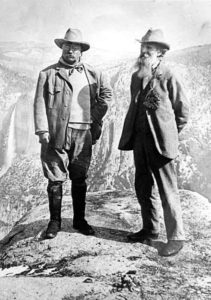 When Teddy Roosevelt and John Muir stood at the same spot as I did for this month’s video, I’m sure they were not thinking about branding as they had their vision for the National Park System in the US. However, I’m sure their thinking was consistent with the first step in creating an effective brand strategy. As I’ve pointed out in all of my branding presentations, the first step is to have a clear vision for your brand and why it will have value to your potential customers. Looking out from Glacier Point that day a century ago, I’m sure that Roosevelt and Muir understood that the beauty and splendor of what they saw (now Yosemite National Park) would add enjoyment and appreciation to generations of Americans and that if this was going to preserve that value, there needed to be a plan (as in brand strategy) to ensure that we maintain these landmark locations for generations to come.
On August 25, 1916, President Woodrow Wilson signed a bill that mandated the agency “to conserve the scenery and the natural and historic objects and wildlife therein, and to provide for the enjoyment of the same in such manner and by such means as will leave them unimpaired for the enjoyment of future generations.” Development of the National Park System was the brand strategy to insure that this bill was successful. The same is true in developing a brand strategy for your product or service. First, you need to recognize that there is a need for the product that can’t be found elsewhere. Dr. Len Berry at Texas A&M noted that a successful brand has “a reason for being” and as you look at many of those brands that have come and gone, you have to ask what was the reason for being in the first place?
Recent successes of brands like Google, Apple, Prius, CarMax and more, all began with a vision of a product or service that provided a new value that customers would recognize and want not only today but also for years (and generations of customers) to come. Certainly, the key to longevity is to constantly review and revise the marketing plans and strategies, but to maintain a long-term brand a marketer has to consistently reflect on the original vision and criteria for the brand and maintain its integrity. The National Park System has grown and adjusted its operations to meet the changing needs and wants of its visitors, yet it stands steadfastly by its original vision of conservation and preservation of their product—the beautiful national parks that people come to see every year.
 I was involved with the original opening and marketing of CarMax in Richmond in 1994. The company was created by Circuit City to capitalize on some of its operational and financial strengths in the electronics business that would translate well to the used car business. It also had a vision to provide a completely new experience in shopping and buying a previously- owned vehicle. Recognizing the many experiences that car buyers had with traditional car dealers, CarMax researched those experiences and then built a totally new concept from the bottom up to provide a value to car buyers. Its vision was to answer the complaints of the car buyer and market it in a creative, intelligent way. The plan has worked as CarMax has thrived (while Circuit City faded away). I believe that CarMax’s new campaign (20 years later) is one of the best in the automotive industry. Click on this link to view one of the new spots (https://youtu.be/1Qkd9AGWU48). Yet it still stands out by addressing the same problems that other dealers still present to their prospective and existing customers. They have a reason for being and a vision to provide a pleasant experience.
Too often, companies develop new communications strategies as nothing more than ad campaigns that lose sight of their original vision and as a result they lose their reason for being in trade for a new slogan or logo. Standing up for the value that the brand provides while remaining fresh and current with your brand messages is critical for long-term success. Just as El Capitan and Half Dome are symbols of the Yosemite National Park, the value and unique selling proposition for your brand must be maintained as the symbols for why your brand was created in the first place.
 1. Create Your Vision: The first step in the customer journey is becoming aware of your product or service. This really starts with you and your company. You need to figure out why the customer would be interested in your product or service in the first place. What makes it different? Why should I be interested in learning more about it? As you develop your brand strategy and options, remember to ask what is going to keep the customer coming back.
 Yum!
Yum!
 Which brings about the question of brand equity. Many believe that if you build top of mind awareness, you have a successful brand. All you have to do is look at Kmart and Sears or Oldsmobile and Plymouth to mention just of few well-known names that just simply weren’t or aren’t relevant any more. As Radio Shack itself admitted in its 2013 Annual Report, the company “struggled to find its place in the market, and more important, with the consumer.” You have to give Radio Shack credit, it was able to spot new technology and become a pioneer in the electronic calculator, then home computers, and later with wireless. Yet, it never became the destination brand for any of them despite aggressive advertising.
 When I got to PetSmart in 1998, the company’s brand was essentially that of a big box, warehouse-type store for pet supplies. It had dog and cat food stacked to the ceilings, and low prices. But it was much, much more. I joined the company because Sam Parker (founder) and Phil Francis (then CEO) told me during our interview dinner that they wanted to have their customers love their stores as much as they loved their pets. You see, for most PetSmart customers their pets were members of their families—not just animals that lived at their houses. This became the foundation of a brand strategy that we developed and essentially still drives the store’s success today. Part of the strategy was to show that PetSmart associates (from the CEO on down to the selling floor) were pet lovers as well. A look at the annual reports revealed not only the officers but also their pets (who shared the official head shots. My family filled the bill. We had a yellow lab that we adopted some 14 years before I joined the company and several other pets along the way. Unfortunately, Cuddles (our lab and family member) passed away a couple months after I moved to Phoenix and joined the company. One of my first orders of business was to let our PetSmart Charities staff know that we wanted to adopt another pup—preferably a smaller breed and a few months later, Winter chose to live with us for the next 14 years.
Recent Comments